
Ilex Opaca: American Holly
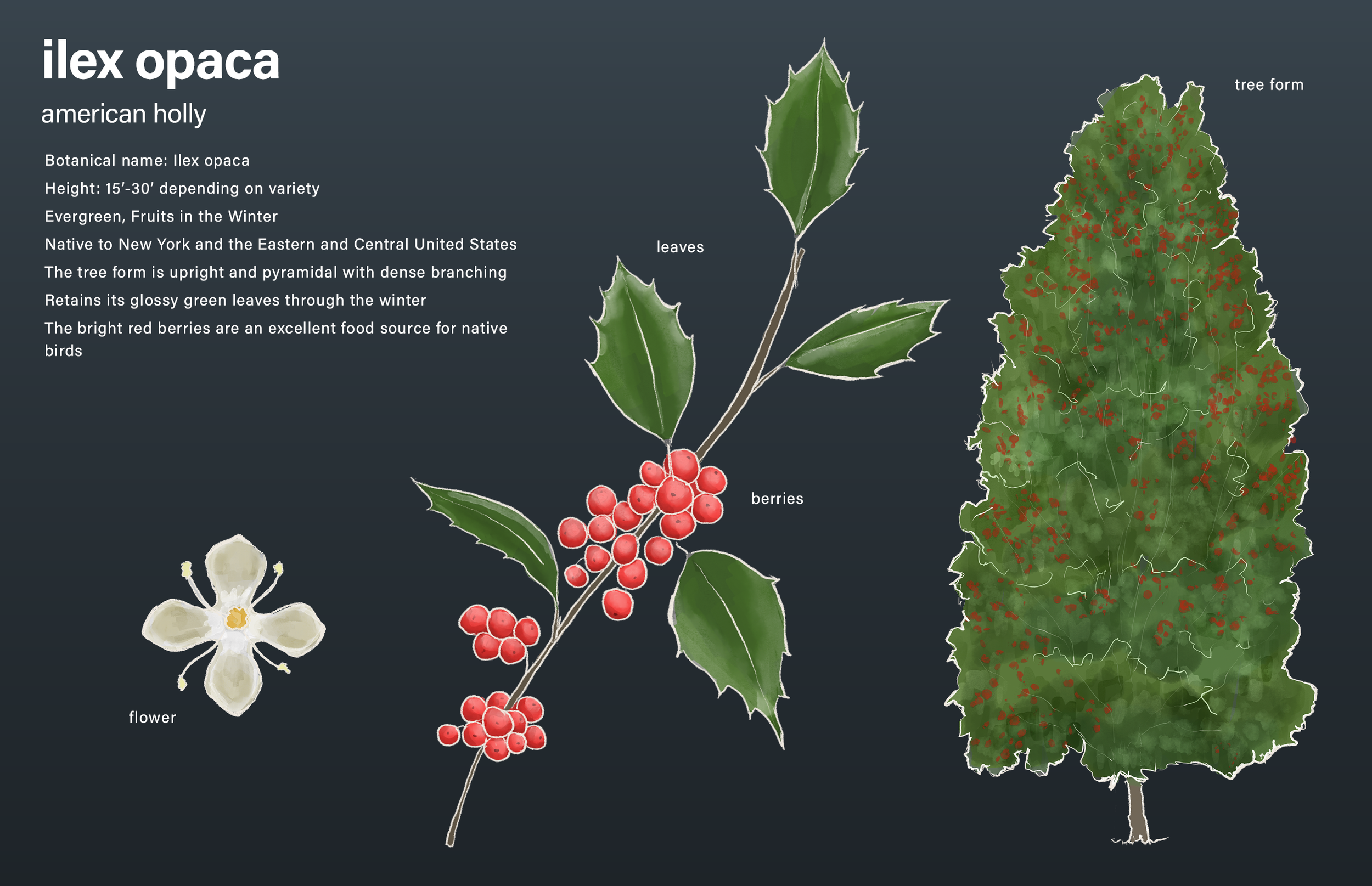
Ilex opaca, commonly known as American Holly, is a broadleaf evergreen native to the eastern and central United States, including New York. Typically reaching 15–30 feet in height, and occasionally taller in favorable conditions, this species develops a dense, pyramidal form with upright branching.
A member of the Aquifoliaceae family, American Holly retains its glossy, dark green leaves year-round. The foliage is leathery and spiny along the margins, an adaptation that discourages herbivory. Leaves are arranged alternately along smooth gray stems, creating a compact and layered canopy structure.
In late spring, the tree produces small, inconspicuous white flowers. The species is dioecious, meaning male and female flowers occur on separate plants. When pollination occurs, female trees develop bright red drupes that persist into winter. These berries are among the plant’s most recognizable features.
Ilex opaca provides critical ecological value.
Its evergreen canopy offers year-round shelter for birds and small mammals, while the winter fruit serves as an important food source during colder months when other resources are scarce. Numerous bird species, including cedar waxwings and robins, rely on holly berries as a winter food supply.
American Holly thrives in well-drained, slightly acidic soils and tolerates partial shade to full sun. In forested settings, it often appears as an understory or mid-story species. Its tolerance for pruning and dense growth habit also make it suitable for screening and wind buffering in designed landscapes.
Beyond its ecological role, Ilex opaca holds cultural significance. Its evergreen foliage and persistent berries have long been associated with winter symbolism in North America.

Within native plant landscapes, American Holly represents durability and seasonal continuity. Its structural form, habitat value, and winter presence contribute both ecological function and visual stability across the year.